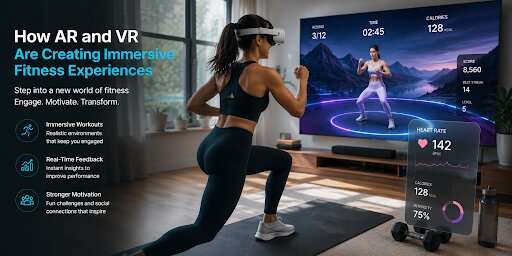
Leon Fischer had done the same 45-minute treadmill session at his local gym in Hamburg every Tuesday and Thursday for two years. Not because he loved it, but because he was consistent enough to show up and bored enough that he had developed a kind of resigned tolerance for it. The scenery was a wall-mounted television showing news he wasn’t listening to and a row of other treadmills he tried not to make eye contact with. He wasn’t going to quit. He also wasn’t going to push himself beyond a comfortable pace that had long since stopped producing any meaningful training adaptation. A friend suggested he try a virtual reality running platform that overlaid a first-person trail running experience through the Scottish Highlands onto his treadmill session, synchronizing the virtual terrain to his actual speed and incline. Leon was skeptical. He used it anyway. His average pace on the same 45-minute session increased by 14% in the first week, not because he was consciously trying harder but because he was chasing something visually, responding to virtual terrain that made pushing over a crest feel instinctively different from pushing through a flat stretch. The boredom that had capped his effort for two years was simply absent. What Leon encountered was the beginning of a shift in fitness experience design that a serious Fitness Application Development Company is now treating as a structural platform evolution rather than a novelty addition: the use of augmented and virtual reality to change the fundamental nature of what exercise feels like from the inside.
Why Immersion Changes Effort Without Changing Intention
The mental process at play when Leon got quicker is known in sports science as attentional dissociation. The brain is so involved in an environment outside of itself that it doesn’t have to devote as much effort to interpreting internal signals, such as how much effort and discomfort one experiences during exercise, which are the primary regulators of self-selected intensity in recreational athletes. A person running on a plain treadmill is acutely conscious of his breathing, his leg fatigue, and the minutes on the countdown timer. When running on a virtual trail, where the running surface interacts with the body, the visual landscape and sound cues interact with the runner, a significantly reduced sense of effort is perceived at the same objective workload.
This isn’t a trick. It’s a legit training workout. The studies that directly compare RPE in VR to conventional circumstances at matched exercise intensity have found that participants in VR report a lower rate of perceived exertion (RPE), while producing the same or greater power output. The implications for fitness application design are that it isn’t simply about increasing the fun of exercise, but about immersion. It’s pushing the limits of what will stay in the user’s head.
Augmented reality provides an additional layer of information: It projects performance data and instructional information into the physical training space – so that the user is not forced to turn their head away from their performance to look at the numbers. Real time power feedback for cyclists that can be viewed in the side sight of the AR glasses, so that these can help to optimize pacing without disrupting physical performance during the session. Immediacy of the feedback a boxer gets when he receives a technique from his AR headset, which superimposes target zones on a heavy bag, would be impossible to replicate with a mirror or a video review system.
VR Fitness Platforms and the Home Training Revolution
Home-based movement VR applications have so far proven most commercially successful in VR fitness. The standalone headset design that lets users of the new Meta Quest platform enjoy engaging fitness experiences without needing an additional sensor or super-computer in their living room or spare bedroom has led to a new generation of fitness apps.
Supernatural, which offers boxing and flow sessions set against photorealistic backgrounds around the world, has proven that those who have had trouble sticking with their home workouts for the past can keep up multiple times a week if it’s designed well and immersive enough. Although it’s not a fitness app, Beat Saber has created a decent amount of cardio training stimulus for people who only do what they want to do because of the fun of enjoying the rhythm-based movements. Its health data it generates for the user of integrated wearables, who track outputs, has been impressive enough to generate some real research interest.
The lesson to be drawn from the most successful VR health apps: it is not a separate issue from fitness design to consider immersion and game mechanics. They are the designer of fitness. Simply using the VR environment for decoration around a standard exercise program doesn’t create the level of engagement that’ll last for a long time, as does incorporating the exercise mechanics into the VR environment. A rhythm track that uses a virtual sword and someone who has to swing it is likely to create a cardiovascular stimulus because the game is played by swinging, and it is also likely to be interesting, not because the game has been designed to be cardiovascular.
Augmented Reality and the Coached Training Environment
Where virtual reality replaces the physical environment with a constructed one, augmented reality enriches the physical environment with layered information and interactive elements. For fitness applications, this distinction determines which training contexts each technology serves best.
AR excels in environments where spatial awareness and physical movement matter: team sports, combat sports, functional training, outdoor running, and gym-based resistance training all involve the physical world in ways that VR’s world-replacement approach can’t accommodate without safety constraints. An AR fitness application that recognizes a user’s body position through computer vision and overlays corrective form cues directly onto their field of view during a squat or deadlift delivers coaching that no mirror, video, or on-screen graphic can replicate.
Computer vision-based form analysis has become one of the most actively developed capabilities in this space. Using the camera in a smartphone or tablet without specialized AR hardware, applications can now estimate joint angles, detect range of motion limitations, and flag compensatory movement patterns with accuracy that approaches what a qualified coach would observe in person. The AR overlay that makes this feedback immediate and spatially relevant rather than delivered as post-session text is the element that transforms diagnostic capability into behavioral change.
The most ambitious AR VR fitness app development projects underway are combining both technologies with real-time physiological data from wearable sensors to create training environments that respond dynamically to the user’s actual biological state. A session that increases its virtual terrain difficulty when heart rate drops below the target training zone, and reduces it when the user approaches their maximum, creates an adaptive challenge that maintains optimal training stimulus throughout the session without requiring the user to manually adjust intensity.
Social Presence and the Group Fitness Problem
One of the most significant barriers to home fitness adoption has always been the absence of the social element that makes group fitness classes, team sports, and gym environments motivationally powerful for many people. The accountability of others being present, the shared effort of working through something difficult alongside other people, and the social norm effect of a group where everyone is training are difficult to replicate through a phone screen showing a live-streamed class.
VR’s capacity for social presence, the sense of actually being in the same space as other people, is substantially stronger than any 2D video interface can produce. Platforms that allow users to train as embodied avatars in shared virtual environments, seeing the movement of other participants in the same virtual space and receiving social feedback from them in real time, are creating group fitness experiences that meaningfully replicate the motivational dynamics of in-person classes.
A virtual spin class where a user can see the effort level of other participants around them, receive verbal encouragement from a physically present instructor whose avatar mirrors their movements, and hear the ambient sound of shared exertion is a qualitatively different experience from watching the same instructor on a screen. Early platforms offering this social VR fitness model are reporting session completion rates and weekly return rates that match or exceed in-person group fitness benchmarks, which represents a significant development in the home fitness value proposition.
The Hardware Trajectory and Its Implications for Developers
Since the AR and VR consumer devices entered the market, the technology has come a long way and even moved forward in a steady pace, and several of the restrictions which currently impact fitness app design will be addressed in the next generation of AR and VR hardware.
Peripheral awareness is less natural in VR than in reality, which can restrict training applications in which a good wide field of view is needed. Improvements in resolution are narrowing the gap between the display’s quality and what’s actually seen in the real world in resolution detail that matters for holding the viewer’s attention. Standalone headsets now are approaching the weight of traditional glasses or sports eyewear, making extended wear while exercising more practical.
It has a particular implication for fitness application developers: those apps designed to use a new generation of hardware will be more likely to benefit from a new generation of hardware without having to be entirely redesigned to do so. It’s a benefit that has been shown in practice by the platforms that have evolved on the various generations of the Meta Quest.
What the Convergence Looks Like in Practice
Tuesdays and Thursdays are different from the days before with Leon on his treadmill. The wall mounted TV is still there. He doesn’t look at it much. He has also increased his tempo from previous times of using the VR platform, and he has now committed to a third session per week as it is no longer an obligation that he’s putting up with. This improvement has been significant enough that he ran a 10K trail race for the first time, in part because he had essentially done almost the same trail type on numerous occasions.
The combination of AR and VR with fitness is yielding results such as Leon’s on a larger scale across different training environments and groups of people that traditional fitness app design never did. It’s very early for the technology and the apps that are working best right now will seem little more than a novelty in 5 years. However, the direction is already clear: immersion will alter the sensation of effort, and the sensation of effort will dictate both the willingness to expend effort and returning frequency and, ultimately, whether a fitness habit will develop and remain. Now, serious fitness app developers are making that chain of causation a fundamental part of their product architecture.